

Checking access information and transportation options is one of the most important aspects of travel planning. Knowing this in advance can genuinely change how your trip feels, so I’m sure you’ll want to gather as much useful information as possible before arriving in Nagoya.
I’ll share my tips for planning the trip in from the airport, as well as getting around Nagoya city. I hope it helps you to build a stress-free schedule and make tons of great memories in Nagoya!
Centrair Airport to the City
The train (Meitetsu) is the standard way into the city. The Meitetsu Airport Line connects Central Japan International Airport Station — directly connected to the terminal — with Meitetsu Nagoya Station.
If your hotel is in Sakae/Fushimi area, Airport Bus (Centrair Limousine) is a good option.
Centrair Airport → Meitetsu Nagoya Station (名鉄名古屋駅) by Train

Option 1
The fastest way into the city is the μSKY Limited Express (all reserved seating).
Travel time: about 28 minutes
Fare: ¥980 base fare + ¥450 μticket (seat reservation) = ¥1,430 total one way
- μticket can be purchased at staffed Meitetsu stations, or touch-panel ticket machines at μSKY-stop stations. ¥450 flat per ride, for any age.
- μSKY has luggage racks at the car ends and generous legroom — designed for airport passengers.
Option 2
If you want to save money, take Limited Express (特急) train with ordinary (non-reserved) cars. Cars 1–2 are first-class cars (¥450 μticket required); the rest are ordinary cars.
Travel time: about 40 minutes
Fare: ¥980 one way, with ordinary (non-reserved) cars
Option 3
Express (急行) or Semi Express (準急) also take you to Meitetsu Nagoya Station.
Travel time: about 45–55 minutes
Fare: ¥980 one way
Frequency:
- μSKY runs roughly twice an hour for most of the day from 7:00, and the last μSKY toward Nagoya leaves around 22:00–22:20; Limited Expresses/Express trains run later.
- Adding Limited Expresses, Express, and Semi Express, trains to Nagoya leave every 10 minutes or so.
- Schedules are subject to change; confirm current departure times on the official website.
If you are taking an ordinary car, you can book the regular one-way ticket in advance on Klook and board with a QR code. One less thing to deal with after a long flight;) If you change your mind and want μSKY or a first-class car, you can buy a ¥450 μticket at the airport station.
Centrair Airport → Sakae/Fushimi by Airport Bus

Meitetsu Bus (名鉄バス) operates the ‘Centrair Limousine’ between the airport and downtown Nagoya (Sakae/Fushimi area). It suits travelers staying at Sakae/Fushimi hotels, or anyone with heavy luggage who wants a one-seat ride to the hotel district without station transfers.
Travel time: about 60 minutes
Fare: ¥2,000/adult (¥1,000/child) one way
Note: the bus does NOT go to Nagoya Station.
- No reservation needed — first come, first served.
- Note that if the bus is full, boarding is not permitted. You will need to wait for the next bus or use alternative transportation.
- From the airport: 8 buses/day, roughly 9:40–21:40 from Terminal 1.
- To the airport: 8 buses/day, roughly 5:57–17:57 from Sakae/Fushimi.
- Cash is not accepted on the cashless trial departures, which are marked on the timetable. On those buses, use a transportation IC card or a contactless credit card instead. Contactless credit cards work on every bus, so that is the simplest option either way.
- For detailed information such as boarding terminals and timetables, please visit the official website.
By Train or by Bus?
If you are going to Nagoya Station, or transferring to JR or Shinkansen, I say train is the best choice. It’s fastest and most frequent.
Staying in Sakae/Fushimi area with big suitcases, Airport bus (Centrair Limousine) is convenient. Slightly slower and pricier than the train + subway combo, but zero transfers.
Cost & Time Comparison to Sakae
| Train (with one transfer at Nagoya) | Train (with one transfer at Kanayama Station) | Airport Bus (direct) | |
|---|---|---|---|
| Cost | ¥1,190 (train ¥980 + subway ¥210) with μSKY, ¥450 additional | ¥1,120 (train ¥910 + subway ¥210) with μSKY, ¥450 additional | ¥2,000 |
| Time | Roughly 50–60 minutes including the transfer walk | Roughly 50–60 minutes including the transfer walk | About 60 minutes door to door |
Tips: μSKY and Limited Expresses also stop at Kanayama Station (金山駅), where you can transfer to JR, Meitetsu, and subway Meijo Line. If you are heading to Osu (Kamimaezu Station/上前津駅) or Atsuta Jingu (Atsuta Jingu Nishi Station/熱田神宮西駅, Atsuta Jingu Temma-cho Station/熱田神宮伝馬町駅), it could be faster to transit at Kanayama.
Getting Around Central Nagoya

The subway is the backbone of transportation within the city. There are 6 lines, fares ¥210–340 (adult). For example, Nagoya Station to Sakae is 2 stops and about 5 minutes on the Higashiyama Line (¥210).
Transportation Bureau City of Nagoya
24-Hour Tickets & 1-Day Tickets
Day passes are also available, and they are perfect for sightseeing. If you’re not sure where you’re headed yet or want to go here and there, you can just hop off wherever you like without stressing over the fare.
Plus, simply showing your valid one-day pass on the day of use, you can enjoy small discounts at various shops and attractions, such as Nagoya Castle, Arimatsu-Narumi Tie-Dyeing Museum, TOYOTA Commemorative Museum of Industry and Technology, and many more.
There are several kinds, but these two 1-day tickets are my personal recommendations. I sometimes use these tickets myself too when I want to hop around the city.
Subway-only 24-hour ticket (地下鉄全線24時間券)
- ¥760/adult, ¥380/child
- Unlimited rides on all subway lines for 24 hours from first use at a ticket gate. Valid across two days within that window; if the period ends mid-journey, the ticket stays valid until you exit.
Donichi Eco Kippu (ドニチエコきっぷ)
- ¥620/adult, ¥310/child
- one-day pass for bus + subway
- Valid only on weekends, holidays, and the 8th of each month
You can buy them at the ticket machines and ticket gate windows (the ticket machines have an English menu as well).
If you want to check the full list of day passes and for further information, please visit the official website.
Sightseeing Loop Bus

If public transport seems complicated and you’re feeling a little unsure about it, the Meguru (メーグル) sightseeing loop bus is another good option. It runs straight to the main tourist spots like Nagoya Castle, Tokugawa Garden, Toyota museum etc.
- ¥210 per ride (¥100/child), 1-day pass ¥500 (buy on board)
- Runs Tue–Sun; no service Mondays (or the following day if Monday is a holiday) and Dec 29–Jan 3
- “Donichi Eco Kippu” is also valid on this bus. “24-hour subway pass” is not.
For more details, please visit the official website: Meguru Nagoya Sightseeing Route Bus
Transit IC Cards

IC cards (Suica, PASMO, ICOCA, manaca, and others) can be used on subways and city buses, as well as on JR and Meitetsu trains, including the line in from the airport.
If you use an iPhone, adding a digital IC card (Suica) to your Apple Wallet is worth considering. You can top it up from your phone instead of queueing at a ticket machine. There is also an app called Welcome Suica Mobile, made for visitors to Japan.
The Nagoya local IC card is manaca;)
Tap to Ride with a Contactless Credit Card (New in September 2026)
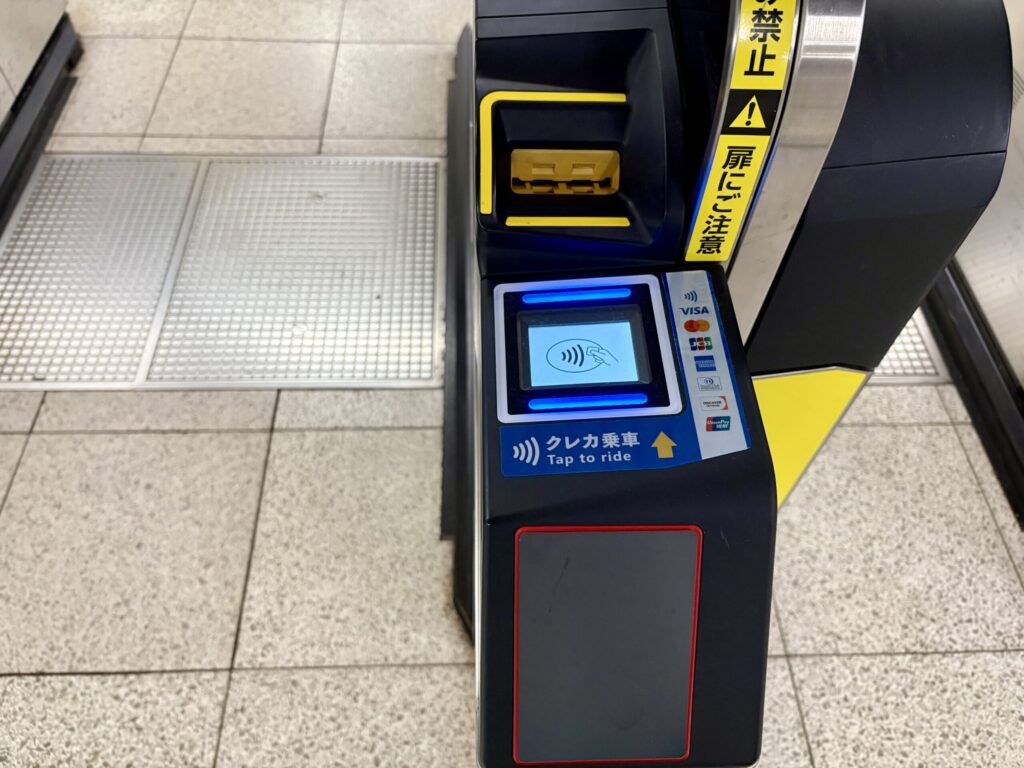
Starting from September 3, 2026, you can ride the Nagoya subway by tapping a contactless credit card at the gate! No pre-registration is required, nothing to top up, and it works at every subway station in the city.
Cards accepted: Visa, Mastercard, JCB, American Express, Diners Club, Discover and UnionPay — or a phone or watch with one of those cards loaded.
How It Works at the Gate
Upon Entry
The contactless reader is located in front of the automatic ticket gate, separate from the IC card panel. Hold your card over it until the light changes from blue to green and you hear a beep, then walk through.
Upon Exit
Do the same on the way out. The fare appears on the gate display. Tap out with the same card you tapped in with.
Note that if you tapped in with the plastic credit card, you cannot exit by tapping your smartphone with the same card loaded. You need to use the same device you used upon entry.
Fares are added up per day and charged the following day or later.
Important Notes
- One card, one person. Everyone in your group needs their own card or phone.
- Regular adult fares only. There are no child fares and no discounts through this system, so for children or discounts, use a ticket or an IC card.
- It cannot be combined with a day pass or any other ticket, and it cannot be used to pay a fare adjustment.
- The system runs at every station, but not every gate has a reader yet. Look for the sticker with the credit card logos around the reader, and use that gate. If you cannot find one, go to the staffed window beside the gates and the staff will take care of it. The remaining gates are being upgraded in stages.
- Not valid on city buses.
Quick tip: the following Meitetsu stations also accept contactless credit card payments: Meitetsu Nagoya (名鉄名古屋), Kanayama (金山), Jingu-mae (神宮前), Central Japan Int’l Airport (中部国際空港), 名鉄岐阜, 笠松, 新木曽川, 名鉄一宮, 国府宮, 東岡崎, Inuyama (犬山), 西尾, 知多半田.
As on the subway, it is one card per person and adult fare only. You can tap in at the airport and tap out in the city, but the tap covers the base fare only; a μticket for μSKY or a first-class car is still bought separately.
Practical Tips — eSIM & Money
One thing worth doing before you leave home is to get your mobile data setting sorted. Well, it is no exaggeration to say that it might be the most important thing these days, right?

I think Japan is easy to travel in, but almost everything runs through your phone — train transfers, restaurant reservations, the map that tells you which of Nagoya Station’s many exits you actually want. My smartphone has been a great ally and helped me out on more trips than I can count;)
Saily’s Japan eSIM connects you to Japanese networks instead of roaming on your own, and you set it up in their app before you fly. It’s data only, so your number stays where it is on your main SIM, and you can share the connection as a hotspot if someone in your group didn’t sort theirs out. Plans run from 1 GB for a short trip up to unlimited, though like every unlimited plan it slows down after heavy use in a day.
Credit cards cover most places in the city, but carrying a small amount of cash is highly recommended. Transit IC card recharges at station machines, small shops, shrines, temples, market stalls, festival food stands, and World Heritage Sites like Shirakawa-go tend to be cash-only.

You can withdraw cash at ATMs in major convenience stores such as 7-Eleven or Lawson, using debit or credit cards issued overseas — Visa and Mastercard are generally accepted. I recommend withdrawing cash as you need it at convenience stores, rather than bringing a large amount from home.
If you are still working out how to spend your days here, my 2–3 day Nagoya itinerary picks up where this guide leaves off.
Have a safe trip and a great time in Nagoya!

Comments